Thermal Behaviour and Long-Term Supply for Micro OLED Wearables
Two engineering problems separate a wearable display prototype from a wearable display product: keeping it comfortable to wear, and keeping it buildable for years. Both are decided early and cost a great deal to fix late. A 0.23-inch 640x400 active-matrix micro OLED helps with the first because it consumes little power and needs no backlight, which removes a heat source as well as a component. It does not solve the second, which is a documentation and sourcing exercise rather than a technical one. Planning both at the same time is what stops a successful prototype from becoming an unbuildable product.
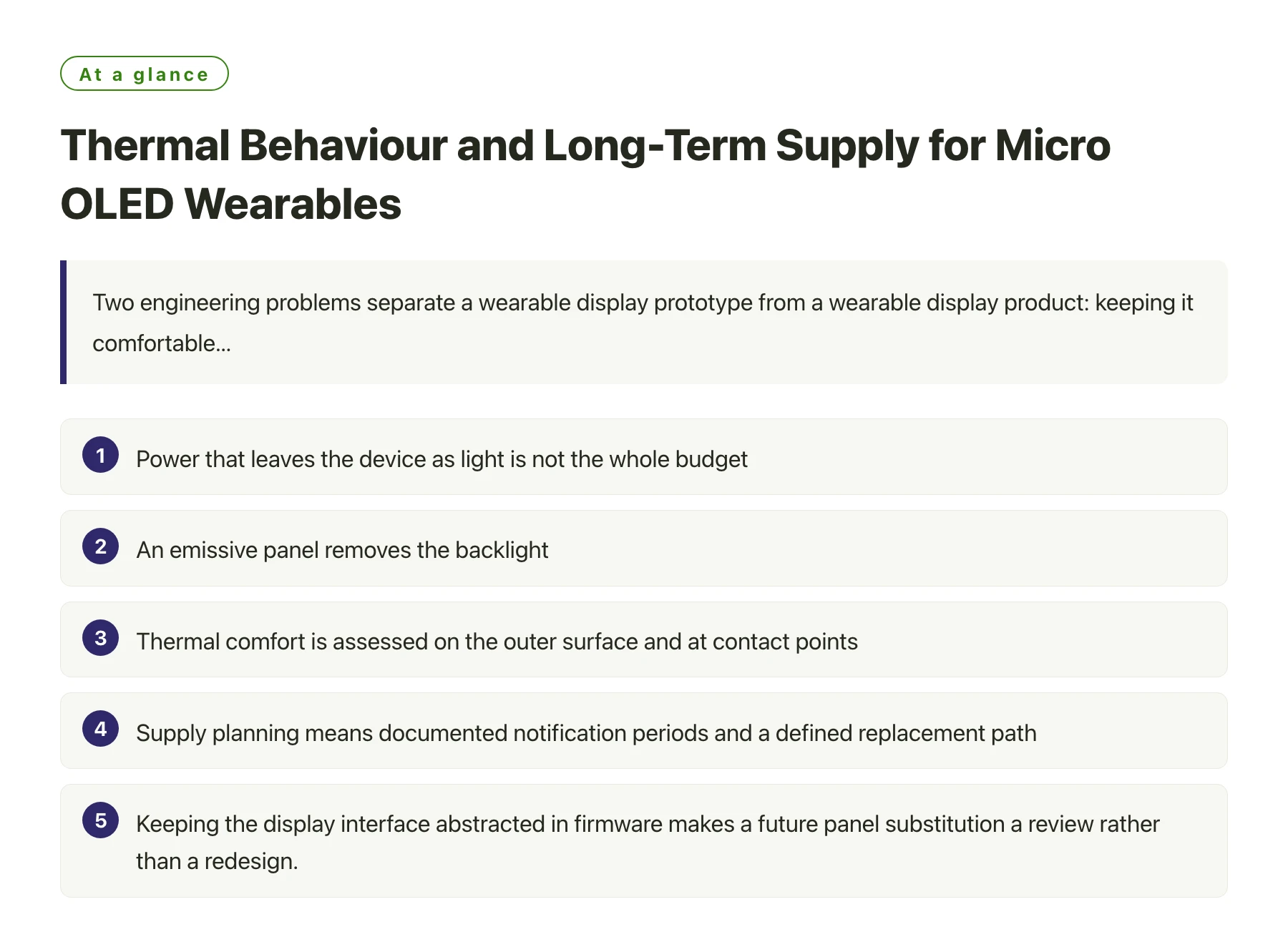
Key takeawaysPower that leaves the device as light is not the whole budget; driver and interface losses also end up as heat near the face. · An emissive panel removes the backlight, which eliminates a component with its own efficiency curve, lifetime and heat path. · Thermal comfort is assessed on the outer surface and at contact points, not on the panel junction, because skin is the sensor that matters. · Supply planning means documented notification periods and a defined replacement path, not a verbal assurance. · Keeping the display interface abstracted in firmware makes a future panel substitution a review rather than a redesign.
Heat in a wearable behaves differently from heat in a handheld. There is no fan, the enclosure is small, and one surface of the device is in continuous contact with skin that is sensitive to small temperature changes. A quantity of waste heat that would be irrelevant in a monitor becomes a comfort complaint in a headset.
The display is not usually the largest contributor, but it is often the most visible one, because it sits in the part of the device that touches the face. That makes its power behaviour worth understanding even when the absolute numbers are small.
Supply is the quieter risk. A design that depends on one module from one source is fine until that module is revised. Deciding how much notice you need, and how tolerant your design is of a substitute, is engineering work that pays off years later.
Why a worn display is a thermal problem
In a handheld device the display is separated from the hand by an air gap and a case wall, and heat spreads through a comparatively large surface. In a wearable the display sits inside a small enclosure with a short path to the skin, and the area available to spread heat is limited by the shape of a face.
The power budget therefore has to be read as a thermal budget. Every milliwatt consumed by the panel, its driver and the interface becomes heat within a few centimetres of the user, and the relevant question is not the total but the temperature rise at the contact points after an hour of use.
The mitigation options are limited. Reducing sustained power is the most effective, whether by lowering drive levels for static content, dimming when the user is not looking, or reducing the refresh activity when nothing is changing. Spreading heat over a larger area, using a metal frame as a thermal mass, and keeping the hottest components away from the brow and temple are the mechanical counterparts.
Failure modes and the design response
| Symptom | Likely cause | Design response |
|---|---|---|
| The device feels hot after twenty minutes | Sustained power in a small enclosure with a short path to skin | Reduce steady-state drive, spread heat over more area, and move hot components away from contact points |
| Comfort varies between users | Contact pressure and area differ, so the same temperature is felt differently | Test with several wearers and design for the worst contact geometry rather than the average |
| Behaviour changes after cold storage | A device brought in from the cold is used before it reaches room temperature [1] | Verify start-up behaviour across the storage range and specify a realistic warm-up expectation |
| Brightness appears to drift over time | Ordinary ageing of an emissive panel, often concentrated where content is static | Shift static interface elements, avoid permanently bright regions, and characterise ageing on the finished assembly |
| The module is revised without warning | Supply arrangements that were never documented | Agree notification periods and a form, fit and function definition before design freeze |
Making the supply question an engineering one
Sourcing risk is usually discussed commercially and mitigated technically, which is the right order but the wrong split. The commercial side agrees how much notice you receive; the technical side decides how much that notice is worth, by determining whether a substitute panel could be made to work.
A design that depends on one exact module, with its timing buried in firmware and its mounting dimensioned to a tenth of a millimetre, will need a full redesign if that module changes. A design that keeps the panel description as data and leaves mechanical tolerance around the module can absorb a substitution in weeks. That tolerance starts with a written baseline, and the published data for a module such as DisplayModule displays is exactly the kind of document a substitute has to be measured against.
What to ask for in writing
Ask for the notification period before a change or discontinuation, the change-control process, and the criteria that define an acceptable replacement. Ask also who manufactures the underlying panel, because a module assembled by one company from a panel made by another has two supply chains and the weaker one sets the risk.
Where a single source is unavoidable, the reasonable position is to document the exposure and design for it. That is a conscious decision, written down, rather than an assumption that a widely used part will always exist. Documenting the exposure also makes it possible to revisit the decision when the product roadmap changes.
Regulatory and material changes affect supply too
Display assemblies are affected by material restrictions and labelling requirements that change over time [2]. A supplier that tracks those changes will reformulate a module rather than discontinue it, but the reformulation is still a change you need to know about, because adhesives and coatings can alter cleaning compatibility and mechanical behaviour.
The practical habit is to keep a short list of characteristics that must not change silently: panel dimensions, connector position, flex length and bend radius, interface mode, and the material declarations that your own compliance file depends on. Anything on that list should trigger a notification and a re-test.
Prototype with the thermal and sourcing questions already answered on paper. Measure the surface temperature at contact points during an hour of realistic use, and write down what you would need to hear from a supplier, and how early, for a module change to be survivable. Both are cheap to do while the design is fluid and expensive to retrofit.
Sources
Frequently asked questions
How much of a wearable's heat comes from the display?
It depends on the content and the brightness used, but the display and its interface are usually a modest share of the total. The reason they attract attention is location: the panel sits close to the face, so even a small amount of heat is felt more readily than the same amount generated elsewhere in the device.
Does an emissive micro OLED reduce thermal load compared with a backlit panel?
It removes the backlight, which is a component with its own efficiency losses and heat path, so the display contributes less waste heat for a given screen luminance. The improvement is real but not unlimited, because driver electronics and interface activity still dissipate power.
How should thermal comfort be measured for a head-worn device?
Measure the outer surface temperature at the points that touch skin, with the device running a realistic content pattern for at least an hour. A single thermocouple reading on the display is not enough, because perceived comfort depends on the contact area and on how evenly the heat is spread.
What does long-term supply protection look like in practice?
A written notification period, an agreed change-control process and a definition of form, fit and function for replacements, combined with a design that keeps the panel configuration as data and leaves mechanical tolerance around the module. The documentation reduces the probability of a crisis; the design work reduces its cost.